

Yarn Substitutions Part 2: Fiber and Structure
I am not going to pretend to be an expert on all the animal and non-animal fibers available to us these days. I’m definitely not. But I have done enough research to be dangerous on this topic, so let’s consider this a primer of sorts, where I’ll define a few of the most common yarn characteristic terms and explain why they’re important.
First, let’s talk about some key yarn terms you’ll come across:
Memory: Does your knitted fabric stretch out and stay stretched forever? It has no memory. Does it spring back into shape after you pull on it? That’s memory. Fibers like wool have natural elasticity (memory), while plant fibers like cotton or linen have none.
Ply: The number of individual strands twisted together to make your yarn. A single-ply yarn is just one single strand of spun fiber. Plied yarns use two or more strands twisted together (2-ply, 3-ply, etc.). Generally speaking, the more plies a yarn has, the stronger it is and the less likely it is to pill.
Twist: How tightly those strands are wound together. A low-twist yarn is fluffy and soft, but it’s more fragile. A high-twist yarn is smooth, dense, and durable.
Non-Superwash (NSW): Wool yarn that has not undergone chemical processes to strip or coat its natural outer scales. Because the scales are intact, the fibers grab onto each other, making the yarn warm, water-resistant, and endlessly squishable. The negative side is that this yarn is likely to felt, so hand-wash in cold water only!
Superwash: Wool yarn that has been treated with a mild acid wash to strip its outer scales and/or coated in a micro-thin polymer resin to prevent felting. This makes the yarn smooth, slick, and machine-washable. While it’s convenient, the trade-off is that superwash wool loses much of its natural bounce and stretches out significantly when wet. It’s not as bad for the environment as plastic yarns, but it’s not as nice as non-superwash either.
Worsted-Spun Wool: Before spinning, long wool fibers are combed so they lie parallel to one another. All the short fibers are combed out. When spun tightly, this parallel structure produces a smooth, dense yarn with virtually no halo.
Woolen-Spun Wool: Before spinning, short wool fibers are carded in all directions. When spun together, they create a soft, lightweight, fluffy yarn.
Halo: Those fuzzy hairs sticking out of your yarn? Think mohair or alpaca yarns. That’s referred to as a halo.
Now that we have those terms under our belt, let’s talk about how they apply to yarn substitutions, starting with structural needs.
Why does memory matter? Well, if a sweater calls for merino wool and you decide to knit it with bamboo yarn, you run the risk of turning a well-fitted, structured garment into a sagging mess. Bamboo is lighter, airier, and great for warm weather, but it lacks elastic recovery. You’d need to pair it with a yarn that has memory to keep it from stretching out over time.
If your pattern relies on crisp stitch definition—like cables, colorwork, or intricate lace—you’ll want a yarn with little to no halo, a higher ply count, and a tighter twist. A worsted-spun yarn is usually your best bet here.
For high-friction items like socks or sleeve cuffs, go with a multi-ply, high-twist yarn to ensure longer-lasting wear and less pilling.
For items that require convenience, for example, If you’re knitting a baby gift and know the parents will need to machine wash it, stay far away from non-superwash, woolen-spun, and single-ply yarns.
Fiber warmth is another big factor. Animal fibers retain heat much better than plant fibers. If you’re knitting for a friend in a hot climate, consider swapping that cashmerino the pattern calls for with a cotton/wool blend—it gives you the structure of wool with the breathability of cotton.
Ultimately, substituting yarn isn't about finding an exact clone of the recommended skein. It's about understanding how these traits work together so you can make intentional choices for your project. Once you know how fiber, twist, and structure behave, you can confidently swap yarns and end up with a finished piece you love.
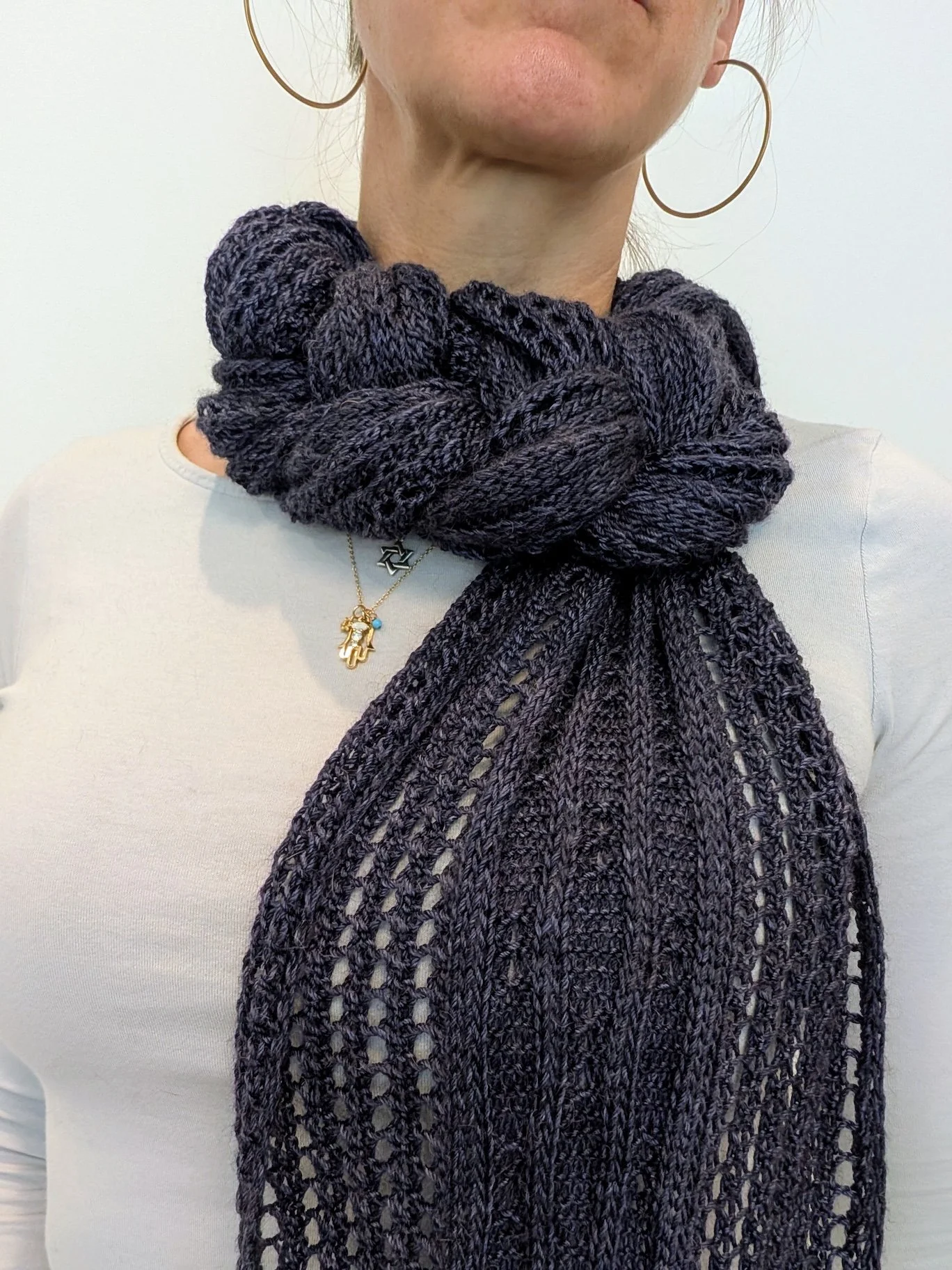
This Arcade Shadows Scarf was knit in a low-twist camel/silk blend in fingering weight. Camel brings soft warmth with moderate elasticity, while silk provides strength, shine, and drape. Because silk doesn't stretch, it anchors the camel fibers to hold the fabric's shape.
Pop Quiz: what budget-friendly yarn would you pick to get a similar drape and warmth for this scarf?