

Demystifying the Center Double Decrease (CDD)
The Center Double Decrease (CDD)—often written as s2kp2 (slip 2, knit 1, pass 2 slipped stitches over) or s2kp (slip 2, knit 1, pass over)—is a decrease stitch that reduces three stitches to one. It is a fundamental technique for creating symmetrical shaping and distinct decorative lines in your knitting projects.
What is the Center Double Decrease?
To execute a CDD, you slip two stitches together knitwise (as if to knit them together), knit the next stitch, and then pass the two slipped stitches over the knit stitch. Slipping the two stitches together reorients them on your right needle, swapping their order so the second stitch sits in front. When you pass the slipped stitches over the knit stitch, that center stitch rests right on top, creating a smooth, vertical column.
Why It Is Used
The CDD is primarily valued for its symmetry and visual impact. Unlike single decreases (like k2tog or ssk) which lean in one direction, the CDD is completely neutral. It is commonly used for:
Decorative Spines: It creates a sharp, "v" shaped architectural line down the center of mitered squares or in lace patterns.
V-Neck Shaping: It provides a clean, neat finish for the center point of a V-neck collar.
Geometric Shaping: By reducing two stitches at once while maintaining a central axis, it allows for steep, symmetrical slopes in garment construction.
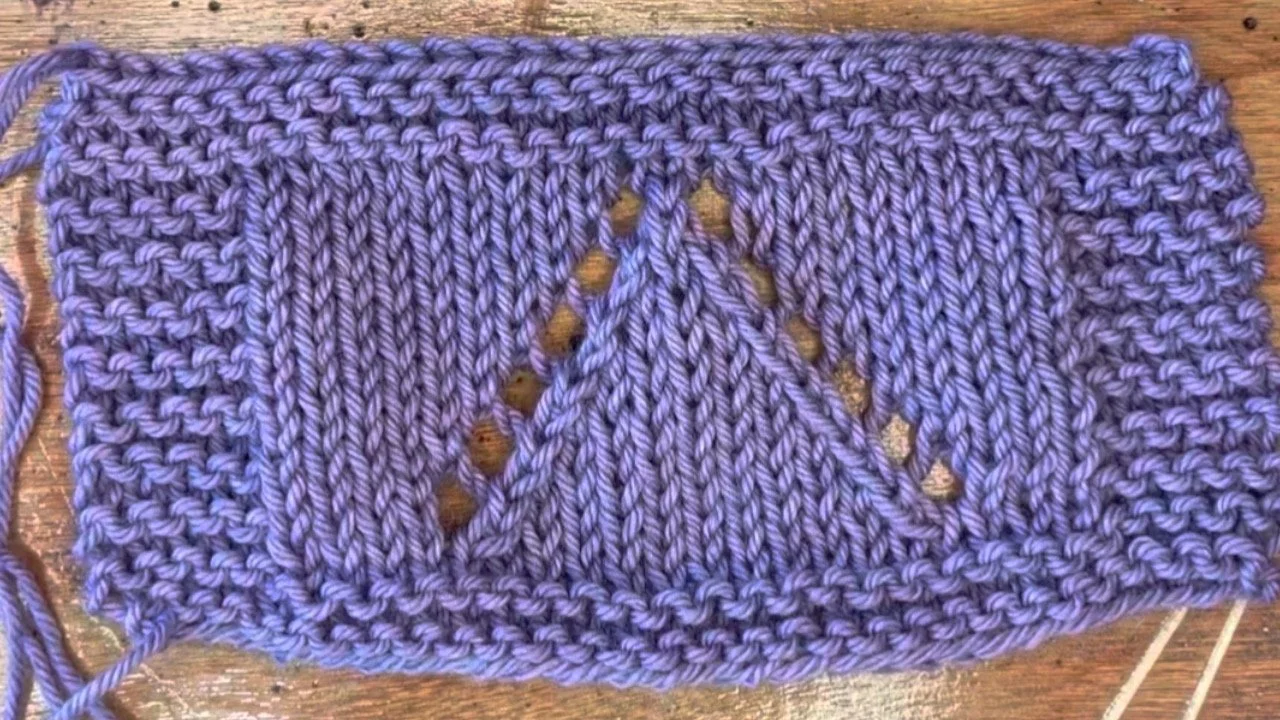
CDD vs. Other Double Decreases
The primary difference between the CDD and other double decreases lies in the slant and the stacking order of the stitches. The CDD keeps the center stitch on top to create a perfectly straight vertical line. Other double decreases create a directional slant: knitting three together (k3tog) leans to the right, while both the sk2p (slip 1, k2tog, psso) and sssk (slip 3, knit through back loops) lean to the left.
Additionally, if you work this decrease by slipping the two stitches individually instead of together, you will end up with a left-leaning double decrease instead of a centered one.
If you’re a visual learner, I’ve created a quick tutorial to show you how to work the Center Double Decrease (and how not to).